
Branded Presentation Folders and Envelopes: Stationery for First Impressions
How branded presentation folders and envelopes make proposals, tenders, admissions packs and client documents look professional, with sizes, finishes and quantities explained.
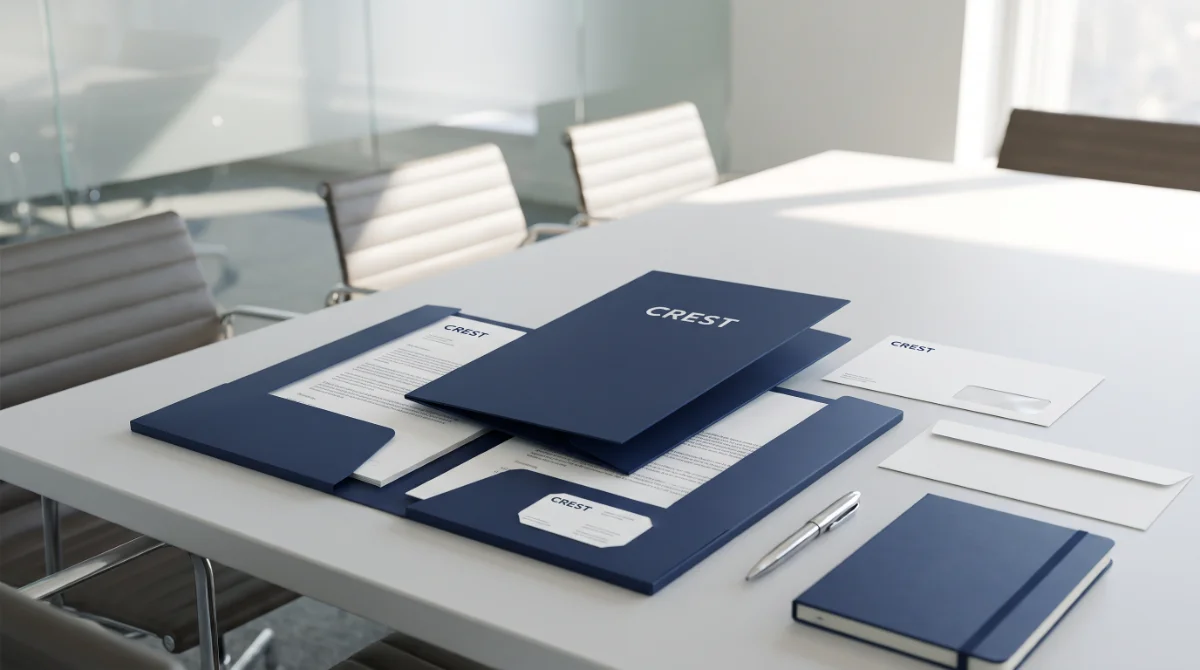
A proposal can be brilliant and still look ordinary if it arrives in a plain manila envelope with loose pages. The same proposal, delivered in a crisp branded folder with a business card tucked into the pocket and sent in a matching printed envelope, looks like it came from a serious, organised company before anyone reads a word. In business, schools and the NGO sector, paper documents still change hands every day, and how they are presented shapes how they are received.
This guide is for consultancies, contractors bidding for tenders, schools and colleges, NGOs, sales teams, law firms and any business that hands over printed documents. It explains where folders and envelopes still matter, the main folder and envelope options, finishes and paper weight, how to build a matching stationery set and how many to order.
Where folders and envelopes still matter
Email has replaced many paper documents, but some of the most important moments in business are still on paper.
- Tenders and bids. Many procurement processes still ask for physical copies of bid documents, delivered sealed. A professional folder inside a sealed, branded envelope makes your bid stand out on the evaluation table. For procurement rules in the public sector, see the Public Procurement Regulatory Authority.
- Proposals and client meetings. A printed proposal in a branded folder gives the client something to keep on their desk after the meeting.
- School and college admissions. Admission letters, fee structures and joining instructions handed over in a school folder feel official and are easy for parents to keep together.
- Welcome and onboarding packs. New clients, members, patients or staff receive their documents in one organised folder.
- Conferences and events. Delegates receive the programme, notes and handouts in a branded folder.
- Invoices, statements and official letters. Printed envelopes make routine mail look professional and easy to recognise.
Folder sizes, pockets and card slots
Presentation folders are designed to hold A4 documents, which is the standard paper size in Kenya and most of the world. The Wikipedia article on ISO 216 explains how A-series paper sizes work.
Our branded presentation folders are made from rigid 350 GSM art board with matte or gloss lamination, with die-cut interior pockets and a slit to hold a business card. An optional expanding spine holds thicker proposals and tender documents, and the outside covers and inside spread are printed in full colour.
When planning a folder, decide:
- How many pockets. One pocket suits short documents; two pockets let you separate, for example, a proposal on one side and the price schedule on the other.
- Whether you need a business card slot, so every folder carries a contact.
- How thick the documents are. For a few pages, a standard flat folder works. For thick tenders and reports, choose an expanding spine.
- What goes inside. The inside spread is often wasted. Use it for your company profile, services, contact details or a short welcome message.
Envelope sizes: DL, C5 and C4
Envelopes come in standard sizes matched to paper sizes. Our branded envelopes come in three:
- DL is the long, slim envelope for an A4 sheet folded into three. It is the standard size for letters, invoices and statements.
- C5 fits an A4 sheet folded once, or an A5 document flat. It suits brochures, cards and small booklets.
- C4 fits an A4 document flat, without folding. It suits proposals, reports, certificates and documents that should not be creased, and it can hold a slim presentation folder.
Our envelopes use 100 GSM or 120 GSM bond paper, with an optional privacy tint inside so the contents cannot be read through the paper, and a peel-and-seal adhesive strip that seals without moistening and shows if the envelope has been opened. The Wikipedia article on envelopes explains international envelope sizes if you need others.
For tenders, a C4 envelope keeps documents flat and sealed. For everyday letters and invoices, DL is the most economical choice.
Finishes and paper weight
The feel of a folder in the hand says a lot about quality. A thin, floppy folder looks cheap, while a rigid, smooth one feels premium.
- Paper weight is measured in GSM. A heavier board, such as 350 GSM, keeps the folder rigid so documents stay flat. Heavier envelope paper feels more substantial and is less see-through.
- Matte lamination gives a soft, modern, non-reflective finish that hides fingerprints. It suits consultancies, law firms and premium brands.
- Gloss lamination makes colours and photos look bright and vivid. It suits schools, events and brands with colourful designs.
Lamination also protects the folder from moisture and wear, which matters for documents that will be handled many times or kept on a desk.
Designing the folder and envelope
Keep the design clean and focused, because stationery represents your brand in formal settings.
- Front cover: logo, company name and a short line about what you do, or a strong image.
- Back cover: contact details, website, physical address and social handles.
- Inside spread: company profile, services, values or a welcome message.
- Envelope: logo and return address on the front top-left corner or on the back flap, leaving the main area clear for the recipient's address.
Use your brand colours and the same logo across folders, envelopes and letterheads. If your brand uses specific colours, give us the Pantone references so they match. Our guide on how to prepare your logo for printing explains file types and colour matching.
Matching your full stationery set
Folders and envelopes work best as part of a set. When everything matches, your documents look like they come from one professional company rather than a collection of different suppliers.
- Pens: a branded pen clipped into the folder pocket gives the client something to sign with and keep.
- Notebooks: a branded notebook is a useful addition for meetings and conference packs.
- Diaries and calendars: for year-end client packs, see our guide to branded diaries and calendars for 2027.
- Welcome packs: for new staff, a folder with policies and contacts fits naturally into the employee welcome kit.
How many to order
Folders and envelopes are used steadily throughout the year, so estimate your monthly use and order for several months at a time.
- Count your typical month. How many proposals, tenders, admissions or client packs do you send? Add the number of letters and invoices you post.
- Plan for peaks. Schools need more folders before admissions, contractors before tender deadlines and conferences before events.
- Order spares. Folders get damaged in bags and envelopes are spoiled when addressed wrongly, so add around 10 percent.
Folders can be ordered from 10 pieces and envelopes from 50, so even a small practice can order what it needs. Larger stationery orders often reach the bulk discount: orders of KES 10,000 or more receive 5% off. Once your design is approved, orders are delivered in 1–5 days.
Tender submissions: getting the details right
Tenders deserve special care, because a small presentation mistake can cost a contract.
- Read the tender document's instructions on packaging first. Many specify the number of copies, how documents should be bound and how envelopes should be labelled and sealed.
- Use one folder per copy, clearly labelled "Original" or "Copy" as the tender requires.
- Choose C4 envelopes so documents are not folded, and seal them properly before delivery.
- Label the envelope exactly as instructed, with the tender number and the name of the procuring entity, and leave enough clear space on the printed envelope for the label.
- Order ahead of deadlines. Tender deadlines are fixed, so keep a stock of folders and envelopes rather than ordering for each bid.
Using folders well in practice
A good folder can still make a poor impression if it is packed badly. A few habits make a difference:
- Put documents in the order the reader needs them, with a cover letter or summary on top.
- Tuck a business card into the card slot of every folder, so the reader always knows who to contact.
- Avoid overfilling. If a folder bulges, use an expanding spine or split the documents into two folders.
- Keep a supply in the office and in the car for sales staff, so they never hand over loose pages.
Folders and envelopes are some of the quietest pieces of branding a business owns, but they are often present at the moments that matter most: the tender that wins a contract, the proposal that lands a client and the admission letter that welcomes a new family. Tell us what you send and how often, and we will help you choose folders and envelopes that make every document look as good as its contents.
Planning event wristbands, staff lanyards, or corporate apparel in Kenya? You can share your design ideas with us directly on WhatsApp for quick digital mockups and pricing.